
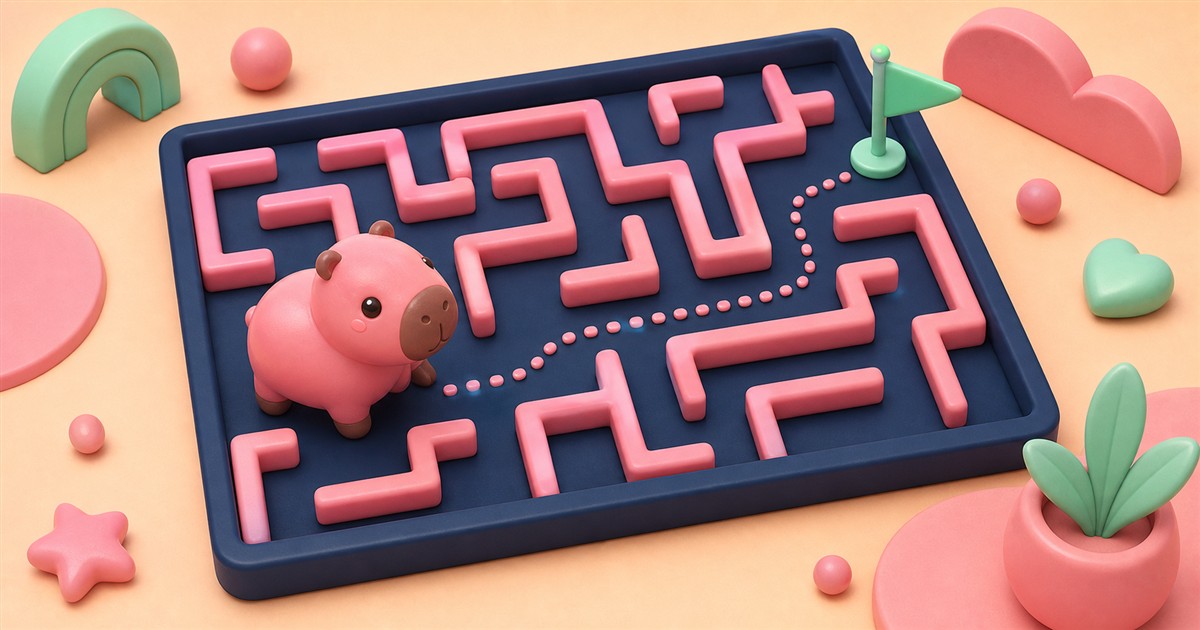
Understand the game before rushing
Each maze is generated as a connected network with one path between any two points. Exploring systematically prevents repeated corridors and reveals the exit even on large boards.
The aim of this guide is to turn that central rule into repeatable decisions. A good result comes from recognising the state of the game, choosing a plan and checking the consequence before acting.
Step-by-step strategy
Choose one wall and keep it on the same side whenever you lose your bearings.
At every junction, remember your arrival direction before testing another branch.
Look several steps ahead and skip corridors whose closed end is already visible.
Apply one idea at a time. Trying to change speed, route and decision rules simultaneously makes it difficult to understand why a game improved or failed.
Example: decide at a three-way junction
You arrive from below and see exits to the left and right. The left branch visibly ends, while the right turns and continues. Remember the junction and test the route that reveals new information.
- Reject the visible dead end without walking its full length.
- Remember that you entered the junction from below.
- If the right branch also closes, return to the same point and take the only untested route.
Common mistakes and how to correct them
- Changing strategy halfway through and revisiting the same branches.
- Moving too quickly to notice junctions that could act as landmarks.
When one of these situations appears, pause before repeating the same input. Identify the earlier decision that created the problem; the useful correction normally happens one or two moves before the visible failure.
A short practice plan
Start on easy and finish three mazes in a row with no more than two backtracks, then increase the size.
Use three to five games for the same objective and compare the pattern, not only the best isolated score. Consistency is the clearest sign that the strategy is becoming a habit.
How scoring works
Difficulty raises the base score; every move and second lowers it.
Leaderboards are useful for comparing results, but first compare against your own personal best and the quality of your decisions.
Frequently asked questions
What is the best first strategy for PinkyLaberinto?
Choose one wall and keep it on the same side whenever you lose your bearings. At every junction, remember your arrival direction before testing another branch.
How is the PinkyLaberinto score calculated?
Difficulty raises the base score; every move and second lowers it.
How can I practise PinkyLaberinto?
Start on easy and finish three mazes in a row with no more than two backtracks, then increase the size.